
We are so happy to announce the winners of this year’s contest, as selected by our judge Sarah Wolfson, our editors, one of our editors’ moms, and you! These poets used all ten of our treacherous words to craft stunning original poems in 48 hours, which will be published in our Fall 2026 issue.
Keep reading to find out what Sarah Wolfson had to say about the 1st, 2nd, and 3rd place winners, and be sure to join us next spring for the 2027 contest!
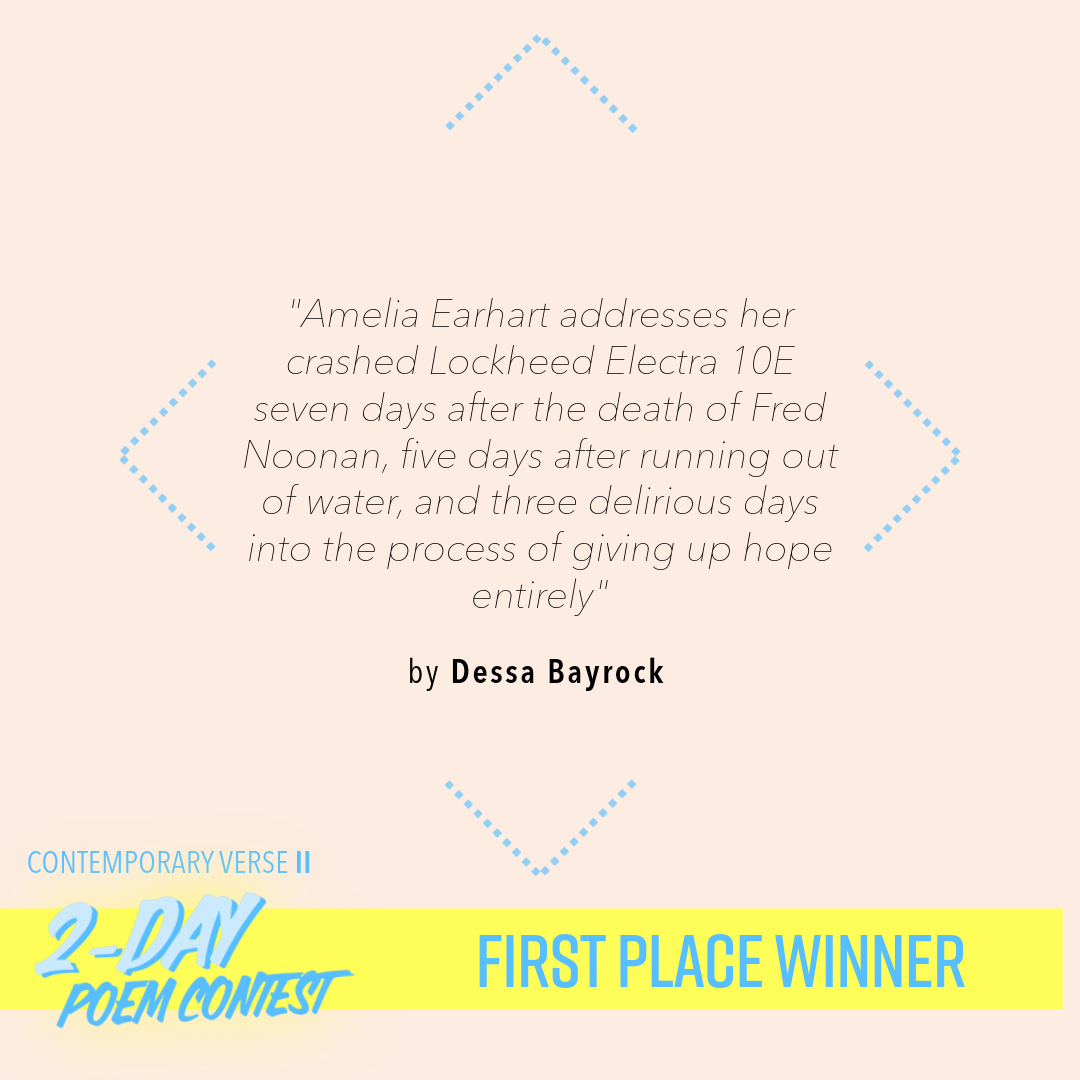
First Place: “Amelia Earhart addresses her crashed Lockheed Electra 10E seven days after the death of Fred Noonan, five days after running out of water, and three delirious days into the process of giving up hope entirely” by Dessa Bayrock
Second Place: “How Things Stand in the Wildfire” by Matthew King
Third Place: “If you call them ’sky rats’ one more time, I’ll scream” by Jade Y. Liu
Editor’s Choice: “Triptych of My Feral Body” by Hayley Clin
People’s Choice: “Self-Portrait With Buried Clams” by Natalie Rice
Editor’s Mom’s Choice: “To Not Let Grief Swallow Me” by Tea Gerbeza
“Amelia Earhart addresses her crashed Lockheed Electra …”
This is a gorgeous poem: atmospheric, embodied, searing. The title’s unapologetic excess signals the writer’s confidence in drawing something new from this well-known figure and fate. Speaking to spiritual matters from a deeply realized sense of physical place, this poem does everything one wants from persona work. It locates a particular speaker at a particular inflection point and then deftly moves the resulting emotional landscape beyond the bounds of the situation. I’m impressed by how the poem confronts not only the proximity of death but also the further-off forces that act on a life. Even as Earhart and her “muttering machine” languish alone in “these moaning trees, the ululation of the wind,” readers are implicated in the larger trappings of spectacle: ticker tape parades, clamouring crowds, ceremonial grief. The poem is stunningly voiced, reaching for all corners of language (“old sport,” “two dumb beasts,” “worse than the corset of sniffishness”). Toward the end, Earhart says simply of the stranded duo, “We could cry, if we had it in us.” But the poem has more in mind than mourning. It’s infused with a contemplative satisfaction of its own making, using the 10 required words to address life’s improbability with an almost hallucinatory joy. In a wonderful lexical flex, the writer pushes beyond the required words, coining “sundoggedly” to seal the near-death meditation. This poem demonstrates how much complexity and feeling language can hold, even — or especially — in a moment stripped back to “honest bone.”
“How Things Stand in the Wildfire”
This poem packs a punch as it accounts for the “spiritual / funk” of habitats facing catastrophic loss. Allusive and full of wordplay, the poem doesn’t simply use the assigned words, it haunts us with them, pressing them into the service of sounding and re-sounding the various fates of living things in environmental crisis. Gesturing at religion and Greek tragedy, the poem asks who warns, who prepares, who stays, and who transcends. I admire the poem’s formal engagement. With its three 10-line stanzas of roughly 10-syllable lines, it offers us three fields of vision (or perhaps three fates, three acts, an ecological trinity). Each stanza dances between rhetorical framing and dense microcosms of sound to examine the (sometimes literal) line between life and death. The writer is virtuosic with figurative language. One of the most brilliant moments in all the poems I read was “a clam unclammed has scrawled its cursive / sentence.” This poem is intense, impassioned, and clever. Like the deer in its final act, it “blaze[s] its courseless steeplechase,” dangling the possibility of a world teeming with life while prophesizing the opposite.
“If you call them ‘sky rats’ one more time, I’ll scream”
Smart and delightful, this poem insists that we question where we cast our attention and why. Its elegant defense of the pigeon models how reorientations of thought can reveal hidden histories lurking in the mundane. The poem transforms its titular scream into an earnest exhortation to acknowledge how “hierarchy nestles itself everywhere.” I admire this poem’s scope, attention, heart, and humour. Everything in its gaze matters: a girl’s braids, “the groggy slumber” of pond life, a Costco hotdog, “bone-tender” instinct. From the city park to shit-covered skyscrapers to past lives, the poem traverses place and time and even vocal register. The tidy couplets fuse plainspoken language with descriptive lyricism, underscoring the poem’s central concern: that what seems ubiquitous and unremarkable might equally well be “a marvel of violet-green shimmers that reflect the light / we choose to give with our eyes.”
Read them all in our upcoming Fall Issue!