A Retraction of Plagiarized Work in the Summer Issue of CV2

CV2 is very sorry to share that a poem we published in our most recent issue, Vol.49.1, the summer 2026 issue, is a work of plagiarism. The piece in question, detailed in the next portion of this statement, plagiarizes the poem “Another Poem About My Father” by Kayla Czaga, which was originally published in 2014 in Kayla’s debut collection of poetry, For Your Safety Please Hold On.

We hereby formally retract the poem titled “Another Poem about My Father”, which appears on page 18 of Vol.49.1 of CV2 Magazine, and which is, on that page, and in the issue’s table of contents, attributed solely to the person who submitted it to us, Kathleen Champoux. The poem we published uses the title, structure, and many near-identical phrases to ones that originated in Kayla’s poem.

Our entire team is sad, sorry, and shocked that we unwittingly published a poem that copied another. We’d like to publicly offer our sincere apologies and heartfelt support to Kayla, whose wellbeing is our top priority during this distressing situation.

There is no way to make this completely right. Out in the world there is now an issue of CV2 that contains work that does not credit its original author, Kayla Czaga. Someone will inevitably pick up the issue, never having seen this notice, nor the retraction we’ll print in our next issue, and will enjoy that poem, unaware that it ought to credit Kayla. That is a devastating reality.

Plagiarism primarily harms the writer whose work gets co-opted in this way – in this case, Kayla. Additionally, it also harms any writer whose work was published alongside the piece in question, as the collection in which their work – in this case many beautiful poems and thoughtful reviews – appears is thereafter, inevitably, somewhat tainted by this situation. Thus, we extend our sympathies to all of the contributors to our summer issue, as well. Our contributors entrust CV2 with their work, and in this instance, it’s hard not to feel that we’ve let them and our readers down. We take some solace in knowing that our community will help us redirect the energy generated by this situation toward uplifting Kayla and her work, as well as the work of all the other writers in this issue, whose writing we are so proud to get to share.

This is a first for the team running CV2, and we hope to navigate the situation as best we can, with the help of our community. To the folks who noticed the similarities in the poems and brought this to our attention, we sincerely thank you. We count ourselves fortunate to have been called in so quickly by our readership, a quickness that not only displays how closely folks read the magazine, but also how much Kayla’s original poem must have impacted them, to have been so readily recognizable in the form in which it appeared in CV2. May we all take a little comfort from that, as well.

Kayla has been unbelievably gracious as we’ve navigated this situation alongside her, and we want to offer her our gratitude for allowing us the chance to take steps toward restorative action in this matter. This statement is one of the first of those steps, and directing as many people as possible to Kayla’s work will be another. To this end, we hope you’ll visit Kayla’s website as well as this blog where you can read her original poem. We hope that, if you have a moment, you’ll go and engage with this stunning piece of writing of Kayla’s, and that you’ll appreciate all the time, effort, skill, and emotion that went into crafting it, as you do so.

Plagiarism is a community issue. With this in mind, we’d like to leave you with the words of Sara Ahmed, who writes about a feminist politics of citation in Living a Feminist Life:

“Citation is feminist memory. Citation is how we acknowledge our debt to those who came before; those who helped us find our way when the way was obscured, because we deviated from the paths we were told to follow.”

Thank you for reading. Thank you for treating this situation with care, and those involved like the fellow flawed humans we all are. Thank you for supporting CV2, and for helping us as we endeavour to support Kayla Czaga, to uplift all of our contributors, and to always do better than we’ve done in the past.

In email correspondence with CV2, Kathleen Champoux acknowledged that this poem ought to have credited Kayla Czaga, and she apologized for what she says was a “horrible mistake.”

Congratulations to the Winners of the 2026 2-Day Poem Contest!

We are so happy to announce the winners of this year’s contest, as selected by our judge Sarah Wolfson, our editors, one of our editors’ moms, and you! These poets used all ten of our treacherous words to craft stunning original poems in 48 hours, which will be published in our Fall 2026 issue.

Keep reading to find out what Sarah Wolfson had to say about the 1st, 2nd, and 3rd place winners, and be sure to join us next spring for the 2027 contest!

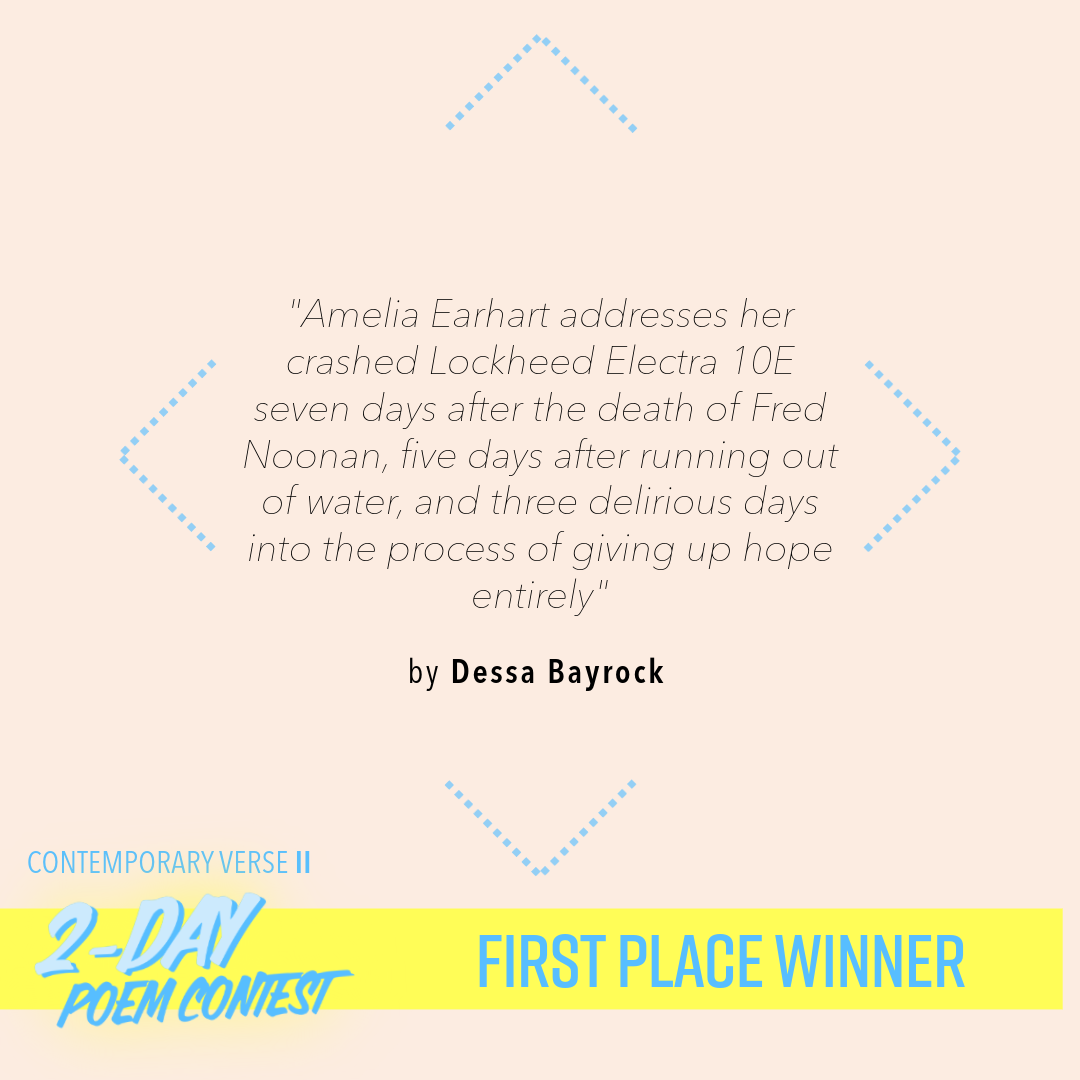
First Place: “Amelia Earhart addresses her crashed Lockheed Electra 10E seven days after the death of Fred Noonan, five days after running out of water, and three delirious days into the process of giving up hope entirely” by Dessa Bayrock

Second Place: “How Things Stand in the Wildfire” by Matthew King

Third Place: “If you call them ’sky rats’ one more time, I’ll scream” by Jade Y. Liu

Editor’s Choice: “Triptych of My Feral Body” by Hayley Clin

People’s Choice: “Self-Portrait With Buried Clams” by Natalie Rice

Editor’s Mom’s Choice: “To Not Let Grief Swallow Me” by Tea Gerbeza


Sarah Wolfson’s comments:


“Amelia Earhart addresses her crashed Lockheed Electra …”

This is a gorgeous poem: atmospheric, embodied, searing. The title’s unapologetic excess signals the writer’s confidence in drawing something new from this well-known figure and fate. Speaking to spiritual matters from a deeply realized sense of physical place, this poem does everything one wants from persona work. It locates a particular speaker at a particular inflection point and then deftly moves the resulting emotional landscape beyond the bounds of the situation. I’m impressed by how the poem confronts not only the proximity of death but also the further-off forces that act on a life. Even as Earhart and her “muttering machine” languish alone in “these moaning trees, the ululation of the wind,” readers are implicated in the larger trappings of spectacle: ticker tape parades, clamouring crowds, ceremonial grief. The poem is stunningly voiced, reaching for all corners of language (“old sport,” “two dumb beasts,” “worse than the corset of sniffishness”). Toward the end, Earhart says simply of the stranded duo, “We could cry, if we had it in us.” But the poem has more in mind than mourning. It’s infused with a contemplative satisfaction of its own making, using the 10 required words to address life’s improbability with an almost hallucinatory joy. In a wonderful lexical flex, the writer pushes beyond the required words, coining “sundoggedly” to seal the near-death meditation. This poem demonstrates how much complexity and feeling language can hold, even — or especially — in a moment stripped back to “honest bone.”


“How Things Stand in the Wildfire”

This poem packs a punch as it accounts for the “spiritual / funk” of habitats facing catastrophic loss. Allusive and full of wordplay, the poem doesn’t simply use the assigned words, it haunts us with them, pressing them into the service of sounding and re-sounding the various fates of living things in environmental crisis. Gesturing at religion and Greek tragedy, the poem asks who warns, who prepares, who stays, and who transcends. I admire the poem’s formal engagement. With its three 10-line stanzas of roughly 10-syllable lines, it offers us three fields of vision (or perhaps three fates, three acts, an ecological trinity). Each stanza dances between rhetorical framing and dense microcosms of sound to examine the (sometimes literal) line between life and death. The writer is virtuosic with figurative language. One of the most brilliant moments in all the poems I read was “a clam unclammed has scrawled its cursive / sentence.” This poem is intense, impassioned, and clever. Like the deer in its final act, it “blaze[s] its courseless steeplechase,” dangling the possibility of a world teeming with life while prophesizing the opposite.


“If you call them ‘sky rats’ one more time, I’ll scream”

Smart and delightful, this poem insists that we question where we cast our attention and why. Its elegant defense of the pigeon models how reorientations of thought can reveal hidden histories lurking in the mundane. The poem transforms its titular scream into an earnest exhortation to acknowledge how “hierarchy nestles itself everywhere.” I admire this poem’s scope, attention, heart, and humour. Everything in its gaze matters: a girl’s braids, “the groggy slumber” of pond life, a Costco hotdog, “bone-tender” instinct. From the city park to shit-covered skyscrapers to past lives, the poem traverses place and time and even vocal register. The tidy couplets fuse plainspoken language with descriptive lyricism, underscoring the poem’s central concern: that what seems ubiquitous and unremarkable might equally well be “a marvel of violet-green shimmers that reflect the light / we choose to give with our eyes.”

Read them all in our upcoming Fall Issue!

Vote for the 2026 2-Day Contest People’s Choice Award!

Voting is now closed. Thanks everyone who voted!

~

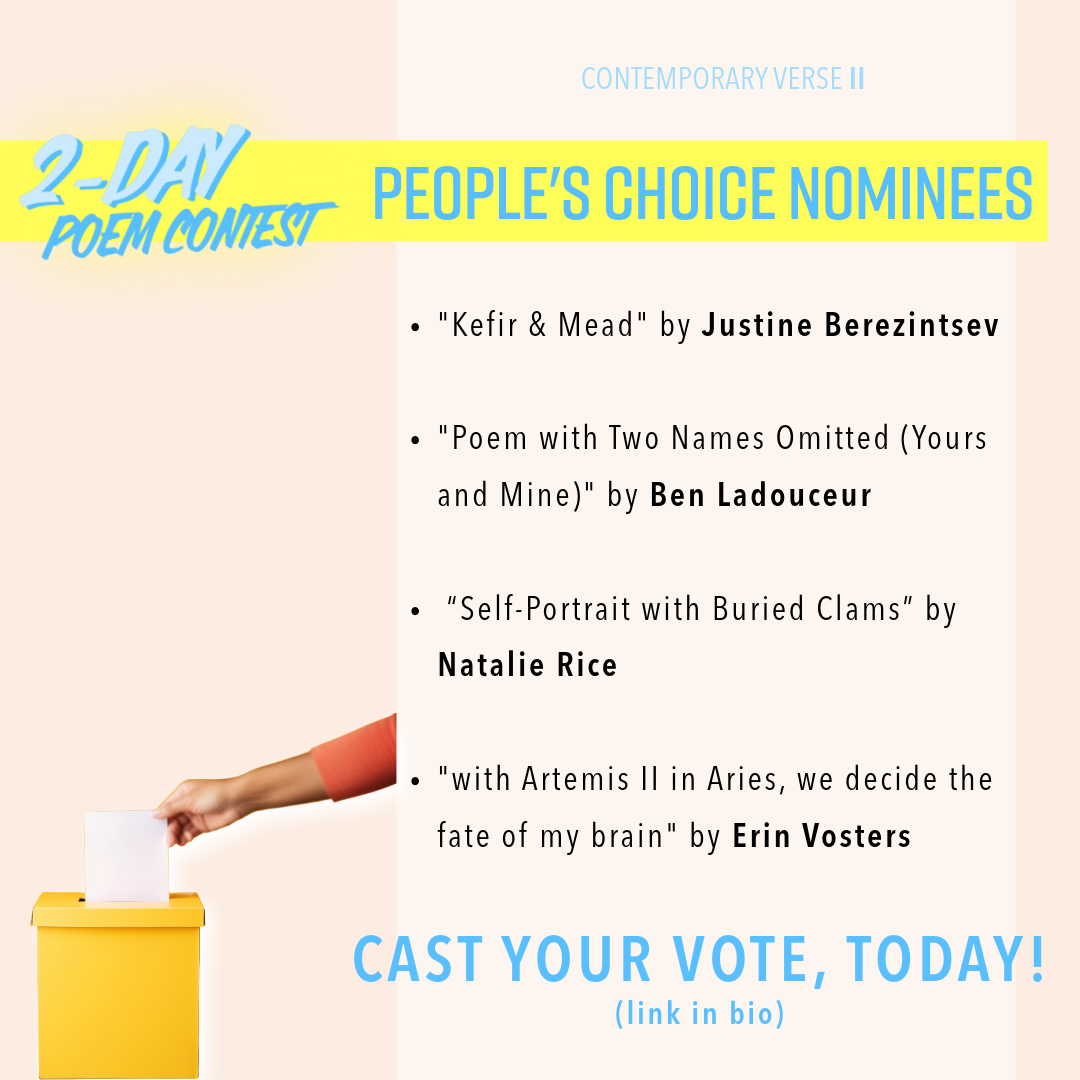
We need your help! Before we can announce the winners of this year’s 2-Day Poem Contest, we need to determine who will win People’s Choice! Here you can read the four finalists. Simply click on the links to view the poems, and vote for your favourite below! Voting will remain open until 11:59pm CT on Friday, July 17th.

The 2026 Foster Poetry Prize is now open!

Calling all emerging poets! The 2026 Foster Poetry Prize is officially open for submissions!

The Foster Poetry Prize awards $1000 and publication in CV2 Magazine to the author of the single best poem submitted to the contest. Second and third place winners and an honourable mention will receive publication in CV2 and $350, $250, and $150 respectively.

The Foster Poetry Prize is open to emerging poets, which we classify as anyone who has not yet published a full-length collection of poetry (chapbooks are fine).

Submit by October 1st and you can include an extra poem in your submission, free of charge! More poems = more chances to win. Final deadline to submit is November 1st. Full contest details are here.

The Foster Poetry Prize is funded in part by generous funding from the Manitoba Arts Council.

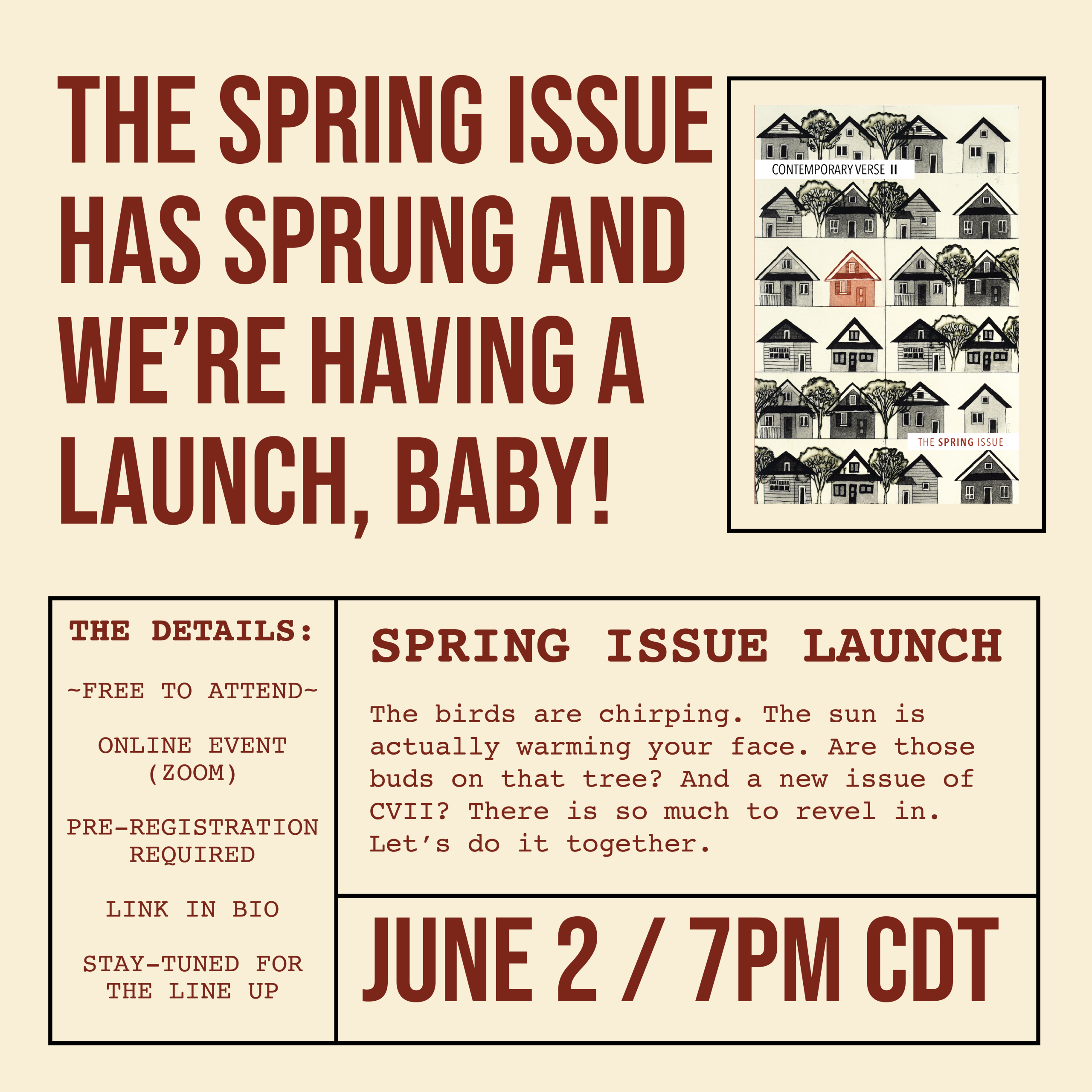
Join us June 2nd for the launch of the Spring Issue!

Join us June 2nd for the launch of the Spring Issue!

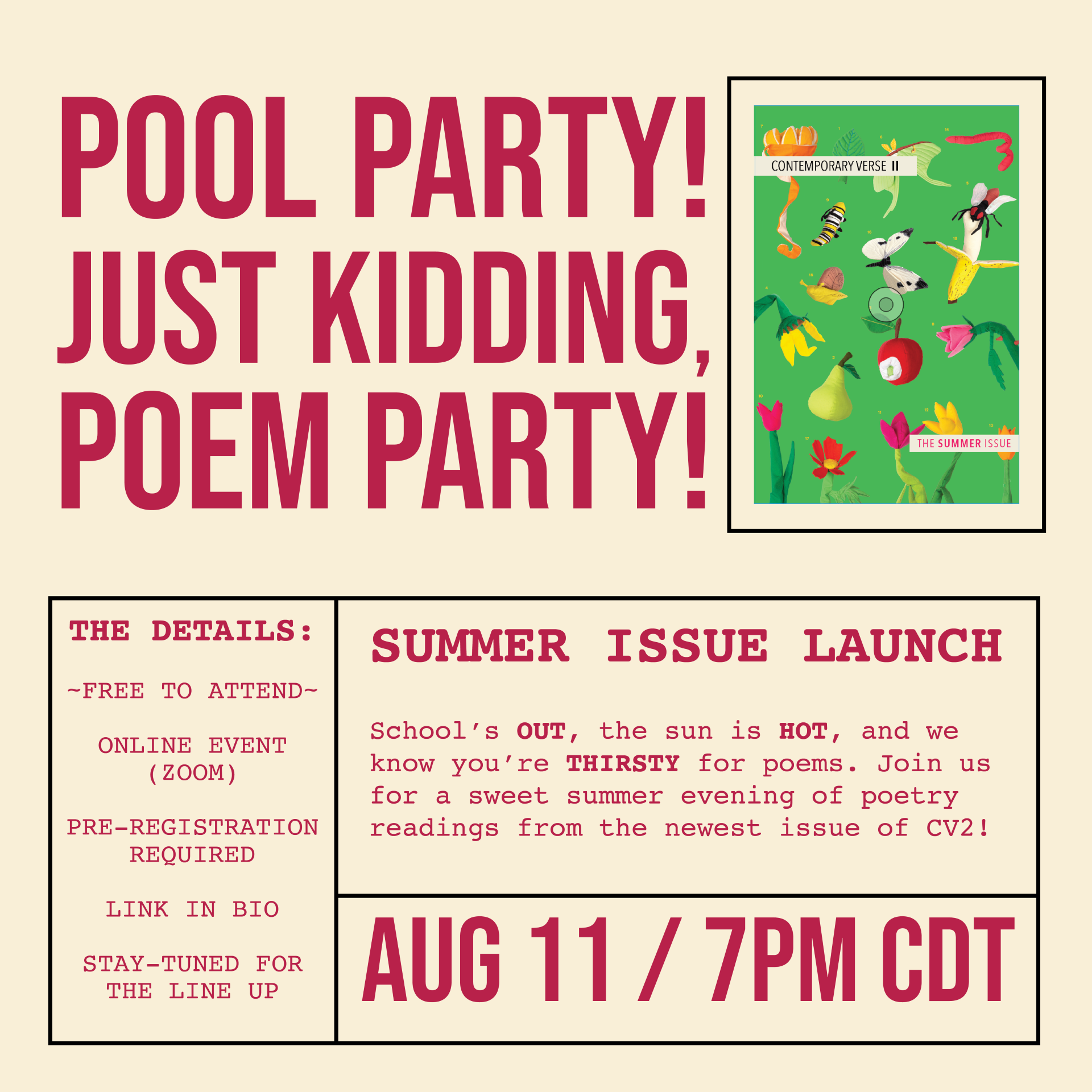
Winnipeg has transitioned from snowstorms to sunshine in the space of a week or two, and we are reveling in the warm breeze, fragrant flowers, and a gorgeous new issue of CV2! The magazine is chock full of fresh poetry and reviews and includes the winners and shortlisters of the 2025 Foster Prize!

Celebrate with us Tuesday, June 2nd at 7pm CST on Zoom. Free to attend – get your invite here!

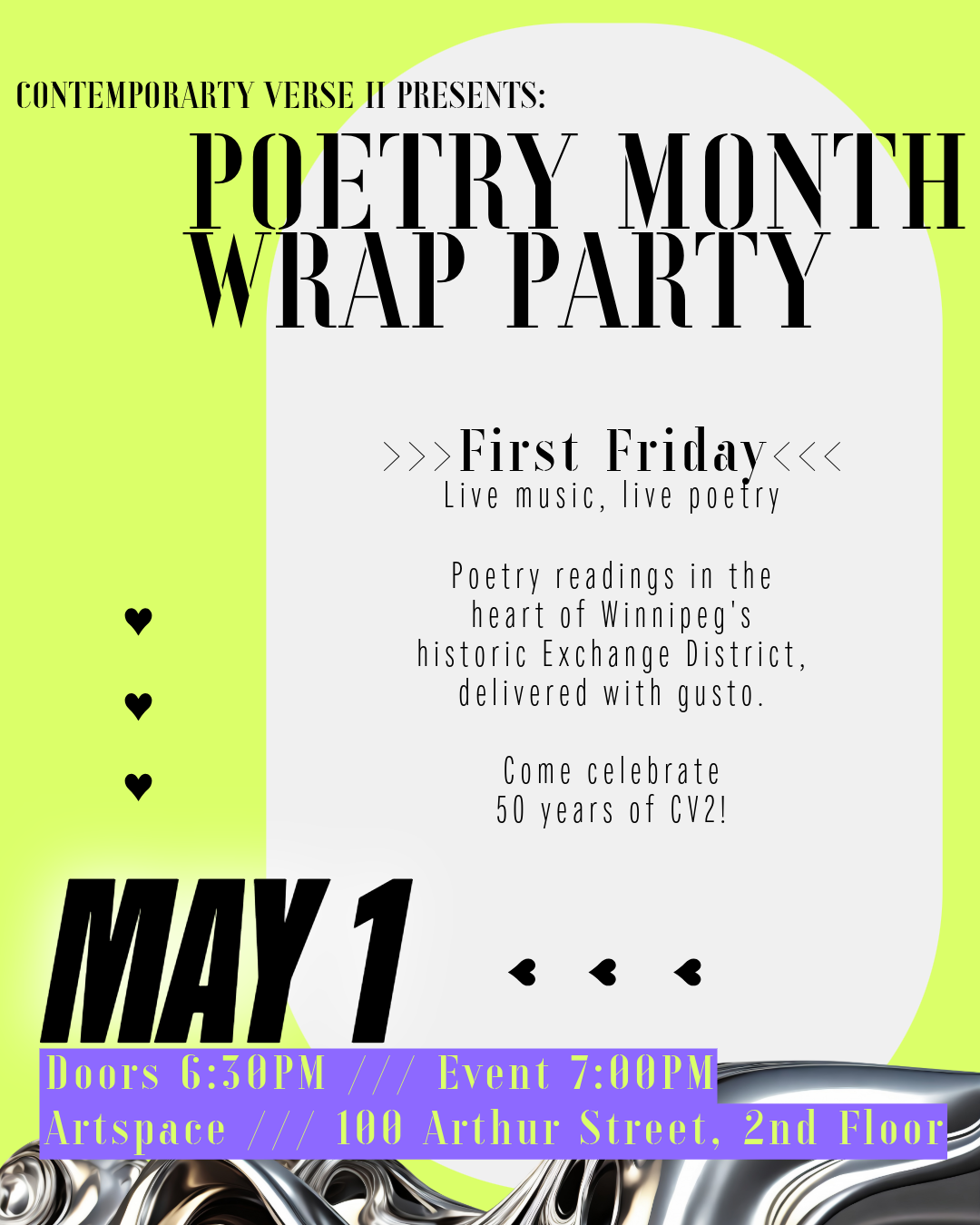
Announcing: CV2’s Poetry Month Wrap Party!

We were heartbroken when our December holiday/birthday/anniversary extravaganza had to be cancelled last minute (Winnipeg weather strikes again!), but we’ve regrouped and are thrilled to invite you to “take two” of our dream party, to (slightly belatedly) celebrate a fruitful 50th year!️️


This event, occurring during the lively First Fridays in the Exchange, also marks the end of National Poetry Month. We’re so happy to be joined by some of the wonderful Winnipeg-based contributors whose work appeared in CV2 this past year! We’ll have readings by J.R. LĂŠveillĂŠ, Catherine Hunter, Sarah Klassen, Jaime Black-Morsette, Sarah Ens, Van Osborne Zimrose, Shawna Dempsey, and George Amabile, as well as live music from Theresa Thor!


We hope you’ll make us part of your First Friday adventures! (And let’s hope for a clear night free from those infamous late-spring Manitoba flash blizzards!)


Friday, May 1st
6:30PM doors / 7:00PM readings
Video Pool Media Arts Centre – 2nd Floor, 100 Arthur Street, Winnipeg
Free/accepting donations

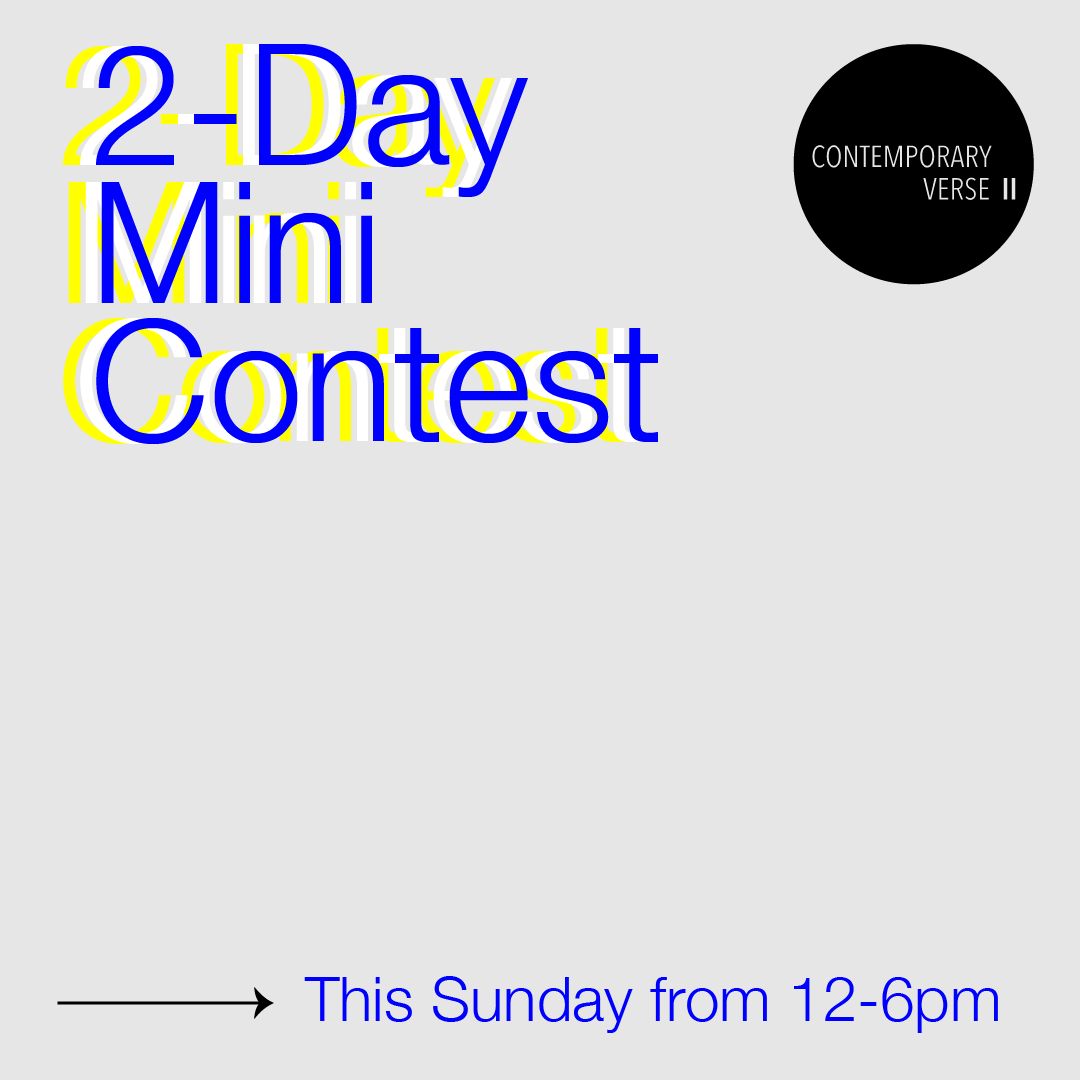
Mini Contest Alert!

✨Dust off your dictionaries! ✨ This Sunday is the second 2026 Mini Contest! We’ve got three more nefarious words from previous years’ contests to get you warmed up for the real deal: the 2-Day Contest, which takes place April 17th-19th.

✨12pm-6pm CT Sunday, March 22nd✨
✨3 words, 6 hours, 1 winner✨

Sunday at 12pm CT we’ll release 3 words. You have six hours to use those three words to write a poem and send it in to us.

In order to play, you must be registered for the 2-Day Poem Contest. If we select you as our winner, your poem will be featured on our social media, and you can choose between having your registration reimbursed or gifting a free registration to a friend!

✨THE RULES✨
– Each word must be used at least once in the body of the final entry. Words may be used in the title, but must also appear in the body of the poem.
– Each word must be spelled exactly as provided. The words may not be used as proper nouns.
– Each word must be used in the proper context to qualify.
– Only one poem may be entered per participant.
– Poems can be DMed to us on social media or emailed to contests@contemporaryverse2.ca – just get them in on time!